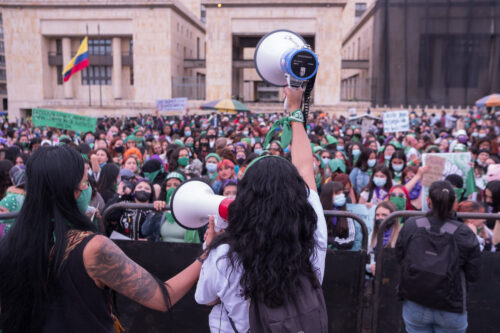
Photo : Lia Valero
Actualités
Fòs Feminista se félicite de la décision de la Cour colombienne de dépénaliser l'avortement
Aujourd'hui décision La décision de la Cour constitutionnelle colombienne de dépénaliser l'avortement est une victoire pour les femmes et les militants des droits de l'homme du monde entier. Cette décision fait suite à une action en justice intentée en 2020 par les organisations de l'Association pour la défense des droits de l'homme. Causa Justa (Just Cause) en Colombie. L'avortement ne sera pas considéré comme une infraction pénale avant la 24e semaine de grossesse. Cette mesure ouvre la voie à l'élimination des obstacles et à la garantie de l'accès à l'avortement en tant que droit et service de santé essentiel.
En réponse à cette décision, Giselle Carino, directrice générale de l'association Fòs Feminista, une alliance féministe internationale qui soutient Causa Justa, a publié la déclaration suivante :
“Nous célébrons la décision de la Cour comme une victoire importante pour toutes les femmes et les filles en Colombie, et en particulier pour les femmes rurales, les survivantes de la violence sexiste et les autres personnes marginalisées qui sont les plus touchées par la criminalisation de l'avortement. Avec nos partenaires locaux en Colombie, nous nous efforcerons d'élargir l'accès à des informations sur l'avortement fondées sur les droits et à des soins d'avortement sûrs, notamment par le biais de la télésanté et de plateformes communautaires, et nous soutiendrons les réseaux d'accompagnement pour les avortements autogérés.
“Bien que notre lutte se poursuive, la décision de la Cour suprême colombienne démontre la force des mouvements féministes qui s'organisent pour exiger la justice en matière de procréation. Nous avons vu l'Argentine, le Mexique et maintenant la Colombie rejeter des lois qui pénalisent et incarcèrent les femmes pour avoir fait des choix concernant leur corps et leur avenir. Enthousiasmés par cette décision révolutionnaire, nous nous joignons aux militants de toute la région pour agiter avec enthousiasme nos mouchoirs verts en signe de solidarité”.”
Aura Carolina Cuasapud, porte-parole de Causa Justa, qui a intenté l'action en justice à l'origine de la décision de la Cour aujourd'hui, s'est exprimée en ces termes :
“Il s'agit d'une décision historique : La Colombie est devenue le premier pays de la région où l'avortement sera légal jusqu'à la 24e semaine. Cela permettra à un plus grand nombre de femmes et de jeunes filles d'avoir la possibilité d'avorter en toute sécurité, en particulier celles qui vivent dans des conditions plus vulnérables. L'arrêt de la Cour permettra également aux prestataires de soins de santé d'éviter la criminalisation et de faire leur travail essentiel de protection des femmes et des jeunes filles. Nous poursuivrons notre combat jusqu'à ce que l'avortement soit complètement effacé du code pénal, mais pour l'instant, nous nous réjouissons. Ce n'est pas la fin, mais plutôt un nouveau départ : Nous devons encore veiller à ce que les services de santé génésique soient accessibles à tous ceux qui en ont besoin.”
Bref historique de la décriminalisation en Colombie :
En 2006, la Cour constitutionnelle colombienne a décidé d'autoriser l'avortement sous réserve de trois exceptions, à savoir causesL'avortement est autorisé par la loi : en cas de viol, de malformation du fœtus et de danger pour la vie et la santé de la femme. Mais les femmes colombiennes continuent de se heurter à de multiples obstacles pour accéder à des avortements légaux. Il s'agit notamment du manque de prestataires de soins de santé qualifiés, des obstacles bureaucratiques à l'obtention de l'autorisation légale de pratiquer l'intervention, et de la stigmatisation omniprésente associée à la criminalisation.
Rien qu'en 2020, le COVID-19 ayant perturbé l'accès aux services de santé de base, y compris les services de reproduction, environ 30 000 femmes et jeunes filles enceintes se sont vu refuser le droit d'avorter légalement. Dans ce contexte, certains 132 000 femmes en Colombie souffrent chaque année de complications dues à des avortements pratiqués dans des conditions dangereuses, ce qui fait de la décision de la Cour non seulement une question de justice sociale, mais aussi une question de droit à la santé.
En décembre 2021, alors que la Cour constitutionnelle était sur le point d'entamer le débat sur la modification du code pénal, l'un des neuf membres du tribunal a été empêché de voter parce qu'il avait précédemment exprimé son point de vue sur l'avortement lors d'un entretien avec un média local. En janvier 2022, les huit juges restants ont voté sur l'affaire de l'avortement, mais il y a eu égalité : quatre pour et quatre contre. Pour les départager, les juges ont dû choisir un membre temporaire de la Cour, qui a eu le dernier mot sur la dépénalisation de l'avortement et a voté en faveur de l'avortement aujourd'hui. Par ailleurs, la Cour a demandé aujourd'hui au Congrès et au gouvernement national d'adopter et de mettre en œuvre une politique permettant à toutes les femmes colombiennes d'avoir accès à un avortement sûr et légal.
La Vague verte :
En décembre 2020, L'Argentine Le Congrès a adopté une loi autorisant les femmes à interrompre leur grossesse au cours du premier trimestre. Cette victoire fait suite à plus d'une décennie d'organisation par divers groupes de la société civile et à des mobilisations nationales au cours desquelles les femmes, les jeunes filles et leurs alliés ont brandi des mouchoirs verts pour symboliser leur demande de justice en matière de procréation.
En septembre 2021, le Cour suprême du Mexique a jugé que les sanctions pénales pour l'avortement étaient inconstitutionnelles parce qu'elles violaient la dignité humaine, l'autonomie, l'égalité, la santé reproductive et la liberté, entre autres droits. La montée de la vague verte en Amérique latine contraste fortement avec les événements aux États-Unis, où les interdictions d'avortement au Texas et dans le Mississippi sont examinées par les cours d'appel des États et par la Cour suprême, respectivement.
###
Fòs Feminista est une alliance féministe internationale centrée sur la santé, les droits et la justice en matière de sexualité et de procréation pour les femmes, les jeunes filles et les personnes de sexe différent. Avec plus de 135 organisations locales à travers le monde, nous nous engageons dans les domaines de la santé, de l'éducation et de la défense des droits pour faire avancer notre programme. Il s'agit notamment de fournir des services de santé sexuelle et génésique et de mettre en œuvre des stratégies communautaires qui rendent les soins de santé sexuelle et génésique plus accessibles aux femmes, aux filles et aux autres personnes en marge de la société. Nous proposons également aux jeunes une éducation sexuelle complète et prodiguons des soins aux victimes de violences sexistes. Nous nous tenons aux côtés de nos partenaires dans la rue, devant les tribunaux et dans d'autres espaces de plaidoyer, en tant que voix féministe sans équivoque, résistant à l'injustice et plaidant pour l'égalité des sexes et les droits génésiques au niveau local et mondial.
La Mesa por la Vida y la Salud de las Mujeres a fondé le mouvement Causa Justa en 2018 en collaboration avec quatre autres organisations : le Center for Reproductive Rights, Católicas por el Derecho a Decidir Colombia, Grupo Médico por el Derecho a Decidir Colombia et Women's Link Worldwide. Le mouvement s'est développé et compte aujourd'hui plus de 90 organisations et plus de 130 personnes. Causa Justa cherche à éliminer le crime d'avortement du code pénal colombien et a déposé une plainte pour inconstitutionnalité à cette fin en 2020.